After considering what both of these phrases actually mean I must say that I prefer assessment FOR learning. The reason I feel this way is because I feel like it encompasses more than just what the student knows. As teachers assessment is just an important for our instruction as it is for the student. When we assess them FOR learning, to me, that means we want to see what they know and how they absorb information so that we can instruct them in a way that suits them the best. When we say OF learning it sounds like we are saying okay, this is what you know and this is what you don't know. The End. Even thought that might not necessarily be the case, that it what prompted me to choose the other phrase.
Here's a short video on Assessment For Learning😊
Basically, the assessment process is a cycle and it is beneficial to the student just as much as it is for the teacher. When we understand how our students learn best and why then we can mold ourselves into being the best teachers for them and they will SUCEED!
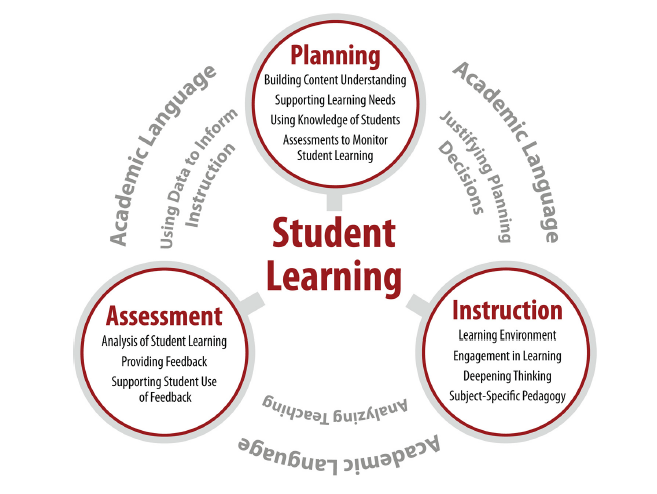
Here's my Extra Credit Professional Development POSTER!
My Thoughts Before reading about the difference between Unit Plans and Lesson Plans my understanding was pretty similar to what I read about. The way I summarized it in my head it that the Unit Plan is a broad topic that is to be taught through individual lesson plans. Each lesson plan makes up the whole Unit Plan.
.
Unit Plans are learning segments made up of about 3-5 lesson plans that build on one another to reach the central focus with a clear learing target & goal.
What Are the Components of an Effective Lesson Plan For All Grade Levels?
Here are some of the thoughts on the articles we read!
Busting the Myths Surrounding the Inquiry-Based Science Classroom
Myth 3: Teaching science through inquiry is chaotic
This myth has more to do with the assumption that the teacher does not have control of her classroom or issue with classroom and behavior management more so than the actual inquiry process. With constant check-ins, one on one discussions and observations as groups are working collaboratively, letting go of some control while teaching can be an integral part of student learning! Increasing student engagement teachers can customize scaffolding to increase the classes level of understanding. This myth stuck out to me because I know that sometimes I tend to be a little controlling in certain situations and I know how excited students get when they are able to take control in their own learning. Of course there may be some chaos, but if you can manage it appropriately it can aid in student learning in a big way! What is Inquiry?
"Inquiry . . . is a process of exploration which is guided by a personal interest or question. It involves risk taking and experimenting which can lead
to pathways where the learner may discover meaningful concepts and
understandings" (Marilyn Austin, Teacher-in-Residence, Exploratorium).
The article compares inquiry to curiousity and how children are constantly in a state of inquiry from the day they are born. We see something, we ask questions and we explore to find the answers we are looking for. Babies and toddlers are always exploring and touching things in their environment. They use all of their senses to figure out the world and objects around them. They see something, pick it up, shake it then usually stick in in their mouths! These actions help us to navigate and make sense of our environment. We are always inquiring and learning whether we realize we are or not!
Here is a video on student inquiry
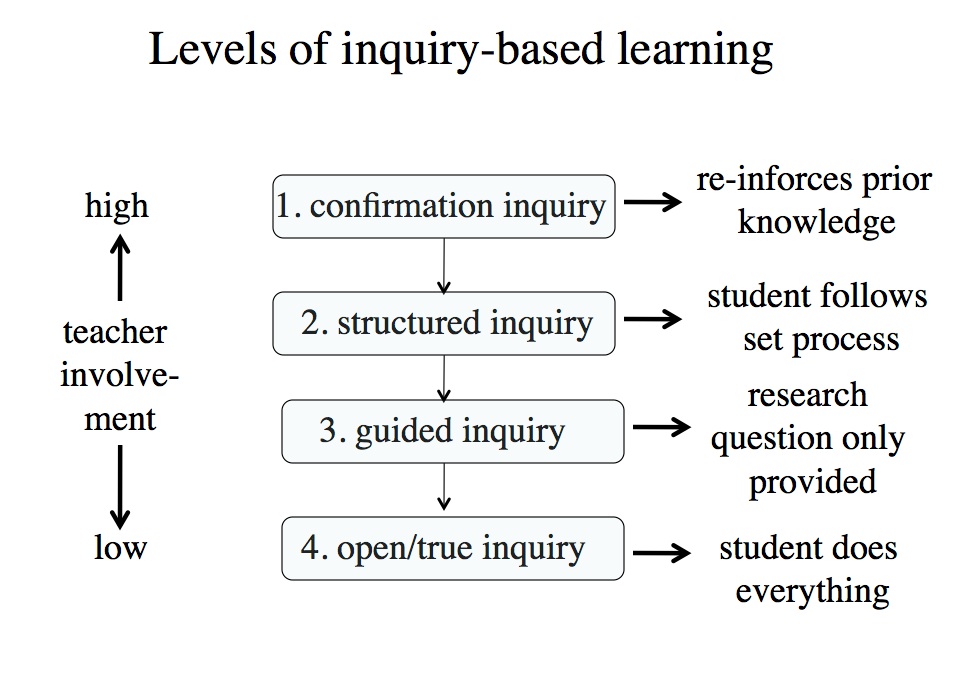
The Inquiry Cycle
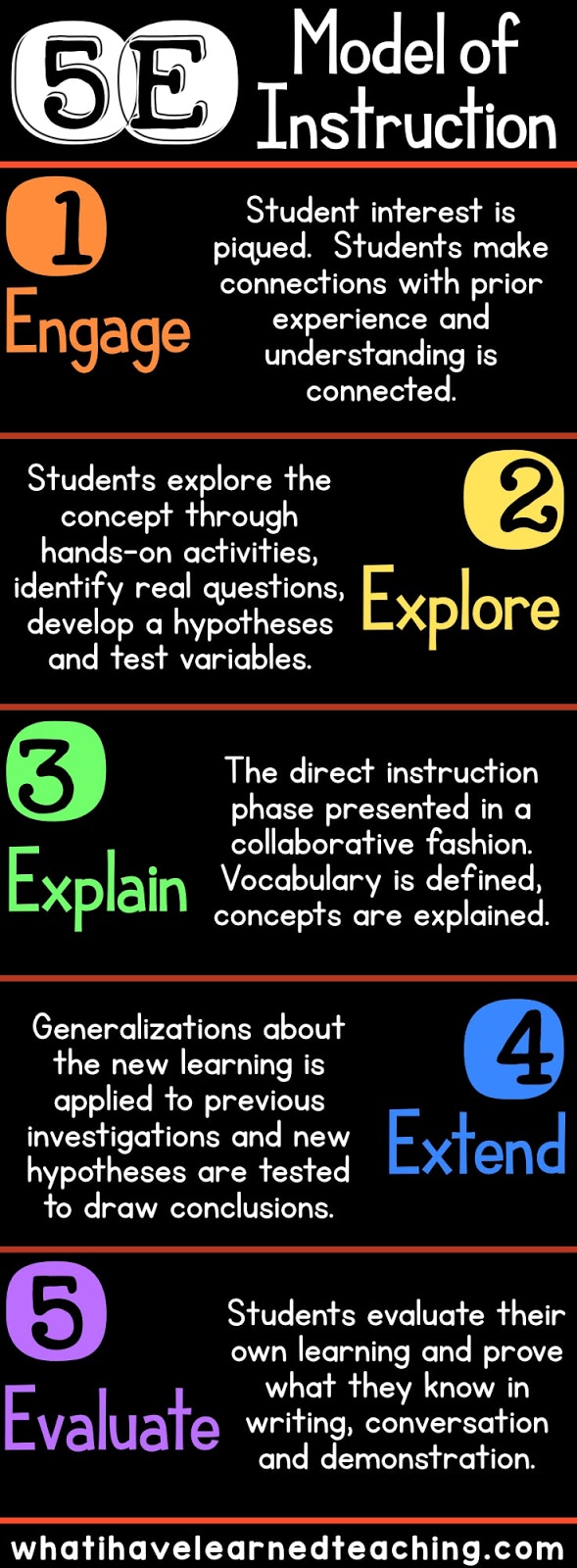
Inquiry, The Learning Cycle and the 5E Model
Active learning is based on the constructivist theory. This theory recognizes that learners will need to:
express their current thinking;
• interact with objects, organisms, substances, and equipment to develop a
range of experiences on which to base their thinking;
• reflect on their thinking by writing and expressing themselves and comparing
what they think with what others think; and
• make connections between their learning experiences and the real world.
The 5E Model creates experiences for students have the opportunity to construct
their understanding of a concept over time
Discover. Learn. Share. When I first started the Scientific Method assignment I was really happy to see a Back to the Future video, I love that movie even though time travel movies tend to confuse me... I found the Science Buddies website about the Scientific Method to be helpful. It not only listed and explained it step by step but it also provided linked resources for us to deepen our understanding. There was even a teacher tool-kit box. I definitely see myself referring back to this link as the semester progresses. The BrainPop video was helpful in explaining the process too. It was a cartoon video that was not to long and wordy which made it easy to follow and remain engaged. After the video I took the quiz, I did not do as well as I wanted the first time so I re-watched the video to brush up where I was lacking. The Science Buddies site stated "When direct experimentation is not possible, scientists modify the scientific method. In fact, there are probably as many versions of the scientific method as there are scientists! But even when modified, the goal remains the same"(Science Buddies, 2019).I found this interesting!
The one thing that has been made clear throughout is that the Scientific Method is not a set method. Since our world is always changing, the ways to explore and discover must adapt to these changes. Its flexible that way. You have to make the method work for whatever your situation may be, and it will not always be the same, BUT thats okay! Steps of the Scientific Method Science Buddies. (2019, August 29). Steps of the Scientific Method. Retrieved from https://www.sciencebuddies.org/science-fair-projects/science-fair/steps-of-the-scientific- ........method#overviewofthescientificmethod
When I think of what science is to me the word EXPLORATION always comes to mind. Scientists are contantsly exploring the world around them and asking questions which lead to DISCOVERIES. My first official scientific experience that I can remember is for a Science Fair project in either 1st or 2nd grade. I made rock candy. The experiment was simple it called for a plastic cup, a sugar water mixturem a string and a pencil. The string got tied down the middle of the pencil and laid on top of the plastic cup with the string dangling down into the sugar water. Then we waited... There was no guarantee it would work but all we could do it try. I do not remember how long we had to wait but it was along the lines of several days. At the end of the experiment we had to lift up the pencil and see if the rock crystals attached to the string. To my luck it WORKED! I had completed my first successful science experiment and could not wait to show my class. That is all I can remember when it comes to acutal science experiments.
But...
When we consider that science happens every day all around us and that we are constantly questioning, exploring and discovering new things it makes my experience as scientist much more advanced. As kid I enjoyed playing outside, I did not like getting dirty and was not huge fan of bugs but my sisters and best friend were so I had no choice! We would dig for earthworms and would get really excited if we ever noticed mushrooms growing in the dirt. We went camping as a family often and behind our campsite was woods and a creek. Everyday we walked around the creek looking for salamanders or frogs or ANYTHING we could find.
Most of my science experiences were outdoors. It was not may favorite subject in school, but I did enjoy biology. I hated Earth Science and dont even get me started on CHEMISTRY!!
Despite it not being my favorite school subject, I do have a positive outlook on Science, it has brought our world into the future. We have science to thank for so much today. I do look forward to building my knowledge and learning to become an AWESOME science teacher!
I will try to remember for my students one day that just because it seems hard and we may not like it, that does not mean that I cant make it FUN!
The first night of class was a lot of fun.
We did many hands on activities, like the scavenger hunt, making our name tags
and creating our scientists. The name tag creations served as an ice breaker to
introducing ourselves to the class. Though many of us have been in classes
together already, Dr. Smirnova was just meeting most of us for the first time.
I always enjoy when I am asked to do something creative in class, I do not see
that as one of my strong points so it takes me out of my comfort zone and
challenges me. One of the reasons that I enjoy the hands on group work is
because it helps us get to know our group members better too. We also played a
game where we had a "what or a who" taped on our foreheads and we had
to ask our group members yes or no questions to help us figure out what
the word on our forehead was. I really enjoyed this game! Once we all answered
we had to figure out what branch of science we fell under and that is how we
formed our Life Science group! Part of our scavenger hunt was to navigate
through our eClass which was helpful in getting familiar with where everything is.
To be honest there is a massive amount of information on eClass that I am still
trying to navigate! I think our first class went really well and it gave me
some ideas for activities that I can use in my classroom one day.
Dr. Smirnova mentioned some videos that
she wanted us to include in our blogs:
"A Vision of
K-12 Students Today":
This video showed how we are currently living
in a technology fueled world. Most students have TV's, computers, iPods etc.
Since our children are engulfed in technology, that is how we should be
reaching them and engaging them in the classroom. There is so much out there to
benefit from and make lessons more hands on and fun in the digital world. It
was surprising to see that at the time this video was made that 63% of
educators were not taking advantage of using technology in the classrooms. I
have notices that many of the "old school" teachers seems to have
issues with technology and feel almost as it is a bad thing, but I think that
its just a feeling of being unsure. We as educators have to recognize that
technology is the "norm" now and we have to embrace this wonderful
tool we have at our fingertips!
"Did You
Know?":
If I had to answer that question based on
the information in this video, my answer would definitely be No! I was shocked by a lot of what I saw here. I know that technology is HUGE but I guess I did
not realize just how huge it really is. It is kind of hard for me to wrap my
head around a lot of the information. The fact that during the time that video
played ( about 3.5 minutes) 274 babies were born in China! What?! To see how
long it used to take for other technologies to reach an audience of 50 million
was eye-opening. It took TV 13 years to reach that many people but it only took
Facebook 2 years, that is crazy. Some of the information really opened my eyes,
like the fact that it is estimated that students will have 10-14 jobs by the
time they are 38, and some of those jobs do not even exist yet. That seems like
a lot of jobs, doesn't it? I am 33 and have had 3 jobs, hopefully 4 (when I
graduate and become a teacher!) ::fingers crossed!::
"Do Schools Kill Creativity":
I really enjoyed the TED talk,
he was very funny and I laughed quite a bit. He states that the class subjects
are ranked the same everywhere in the world and the arts are always ranked at
the bottom. When schools need to cut their budgets the arts and music are the
first ones to go. So he raises the question of why? Why aren't these subjects
considered to be important. As an education student one of the many things I
have learned is that children learn better when they are active and engaged,
yet the schools are not honoring this theory. These programs promote creativity
and when we do that students aren't getting a proper outlet for it. For some
reason we teach our children that our knowledge is solely based on our academic
ability and not our creativity and that if we are failing certain subjects
there is something wrong. Some kids get in trouble for daydreaming or getting
out of their seats too much, but this is mainly because those areas of our
brain need to be exercised more, and schools are not allowing
it.
My course expectations:
I hope to learn
new and exciting ways to teach science to students and how to bring technology
into my classroom in a fun and fulfilling way.