Wednesday, December 4, 2019

Flipped Classroom

Image result for flipped classroom"On September 16th we experienced a flipped classroom! By definition a flipped classroom is a pedagogical approach in which the conventional notion of classroom-based learning is inverted, so that students are introduced to the learning material before class, with classroom time then being used to deepen understanding through discussion with peers and problem-solving activities facilitated by teachers.

We presented our infographic posters to eachother- an activity that went along with our Scientific method/ Inquiry Hyperdoc. I was caught off guard by this but I learned alot after being  put on the spot. These moments when we have to present and may not be prepared to do so are the time when we learn the most in my opinion. I realized that I do not need to doubt myself so much, I was nervous because I did not think I was knowledgeable enough on the topic but I was wrong! Not only did I learn about the topics from my colleagues but I was also able to take note of how they present, how they speak, the way they stand etc. I was out of my comfort zone for sure during this presentation, but that is how we grow. 

I enjoyed this approach more than sitting through a lecture. I feel many times in the classroom, we listen to HOW to do something and we are really just waiting to DO it. After all we are in this program because we want to TEACH so at some point we will have to be totally comfortable presenting information to young inquiring minds. It was all good practice!
Image result for flipped classroom benefits"

Tuesday, November 26, 2019

No Grades? Tell me more!

Teaching Without Grades: A year of lesson's from a no grades classroom 


As a student AND future teacher this article spoke to me as I am living on both sides of this. In the article the author discusses how he does not enjoy grading students writing pieces because he realizes that the students care more about the grade than the actual piece they are writing. It makes you think, are we teaching students to get good grades or are we teaching them material and skills? It seems like grades have always been of utmost importance, and I can speak from experience that I often remember my grades on work than the actual work I did. I have had several writing courses that I really enjoyed the process. To me, writing is something that makes me feel vulnerable because I really have to open up a part of me that I dont access all the time. So when I feel I have opened up and then got a grade that did not reflect the effort that I put into it, it is more than disappointing.

Image result for teaching without grades"I think having students self assess is very important in the learning process. This keeps the students engaged and accountable for their own education.It forces students not only remark on what they still need to work on, but also to point out their strengths. As a student I have difficulty pointing out my own strengths but my weaknesses are much easier for me to point out. We tend to be hard on ourselves, but its important that we recognize we have strengths and they matter.

I am not surprised that some students liked no grades and that some were not as thrilled. Some of the students said it helped them focus more on the work and not the grade, and others said not having the visual of their grade caused them to slack off a bit. That was reflected in the teachers feedback- as some students handed in late work often once this method was implemented in the classroom.

As a teacher I do not know if this is a method I would use. I would most likely discuss it with my students and possibly have a class vote to see if it was something we should try. Just from this article you can see the amount of work that goes into not using grades. So my question is would it pay off to not grade or would it end up making my job even more difficult?
Image result for no grades comic"

Thursday, November 21, 2019

Teaching with Tradebooks Experience

I have to make a Book Trailer?!


This was my first thought when I saw this assignment, I can't lie and say I wasn't intimidated...at first. Once I got my book and began the book trailer it was surprisingly much easier than I thought it would be, all thanks to the great digital resources that Dr. Smirnova provided for us. I chose Animoto as my platform and I had a lot of fun making mine. At first I was thinking there is NO way I am using my voice in this thing, but I ended up doing 2 voiceovers! I really got into creating this book trailer, even though I had been dreading it for quite some time.

I did feel a little limited when searching for books that related to my Unit Plan topic, the 5 senses. I realized that I was looking at  it the wrong way, I was so set on fiding a book that was specifically about the senses that I was overlooking the wonderful books that involved the senses without ONLY being about them. This opened up a new door of options for me and made it a more enjoyable experience.


After completing my trailer for Farley Follows His Nose I began thinking about the ways I could use this in my classroom one day. Obviously I could use it in a 5 senses unit since I have already done that; but there are other ways to use it. In the book the dog,  Farley, smells alot of delicious food and uses descriptive words when describing them. It could be a great book to teach new vocabulary, or to make a word wall with the words we come up with to describe certain smells. There could be a scavenger hunt where the students walk around finding items that could fit the described scent (i.e:  food from cafeteria, scented soap, scented markers, lotions.)
Although I grew up with computers and technology, I still get intimidated when it comes to using technology for a project from start to finish. Thanks to sites like Animoto or Powtoon for example, It makes the whole process much less daunting. It guides you step by step which is SO helpful! I wouldn't say that I am anti- tech, but I would admit that I can be tech-hesitant. This class has pushed me out of my comfort zone for many assignements and I am grateful for that. I am grateful for that and I am proud of the work I have done that I normally would have done in a different, probably more boring way!

Take a look at my finished project here:
My Book Trailer!

Wednesday, October 23, 2019

Assessment OF Learning vs. Assessment FOR Learning

After considering what both of these phrases actually mean I must say that I prefer assessment FOR learning. The reason I feel this way is because I feel like it encompasses more than just what the student knows. As teachers assessment is just an important for our instruction as it is for the student. When we assess them FOR learning, to me, that means we want to see what they know and how they absorb information so that we can instruct them in a way that suits them the best. When we say OF learning it sounds like we are saying okay, this is what you know and this is what you don't know. The End. Even thought that might not necessarily be the case, that it what prompted me to choose the other phrase.

Here's a short video on Assessment For Learning😊


Basically, the assessment process is a cycle and it is beneficial to the student just as much as it is for the teacher. When we understand how our students learn best and why then we can mold ourselves into being the best teachers for them and they will SUCEED!

Here's my Extra Credit Professional Development POSTER!


Friday, October 11, 2019

Unit Plan vs. Lesson Plan


My Thoughts
Before reading about the difference between Unit Plans and Lesson Plans my understanding was pretty similar to what I read about. The way I summarized it in my head it that the Unit Plan is a broad topic that is to be taught through individual lesson plans. Each lesson plan makes up the whole Unit Plan.

. 
Unit Plans are learning segments made up of about 3-5 lesson plans that build on one another to reach the central focus with a clear learing target & goal.

What Are the Components of an Effective Lesson Plan For All Grade Levels?

  1. Necessary Materials
  2. Clear Objectives
  3. Background Knowledge
  4. Direct Instruction
  5. Student Practice
  6. Closure
  7. Demonstration of Learning (Quick Assessment)


Wednesday, October 9, 2019

Inquiry and the 5 E's

Here are some of the thoughts on the articles we read!

Busting the Myths Surrounding the Inquiry-Based Science Classroom

Myth 3:  Teaching science through inquiry is chaotic
This myth has more to do with the assumption that the teacher does not have control of her classroom or issue with classroom and behavior management more so than the actual inquiry process. With constant check-ins, one on one discussions and observations as groups are working collaboratively, letting go of some control while teaching can be an integral part of student learning! Increasing student engagement teachers can customize scaffolding to increase the classes level of understanding. This myth stuck out to me because I know that sometimes I tend to be a little controlling in certain situations and I know how excited students get when they are able to take control in their own learning. Of course there may be some chaos, but if you can manage it appropriately it can aid in student learning in a big way!

What is Inquiry?

"Inquiry . . . is a process of exploration which is guided by a personal interest or question. It involves risk taking and experimenting which can lead to pathways where the learner may discover meaningful concepts and understandings" (Marilyn Austin, Teacher-in-Residence, Exploratorium).
The article compares inquiry to curiousity and how children are constantly in a state of inquiry from the day they are born. We see something, we ask questions and we explore to find the answers we are looking for. Babies and toddlers are always exploring and touching things in their environment. They use all of their senses to figure out the world and objects around them. They see something, pick it up, shake it then usually stick in in their mouths! These actions help us to navigate and make sense of our environment. We are always inquiring and learning whether we realize we are or not!

Here is a video on student inquiry


The Inquiry Cycle


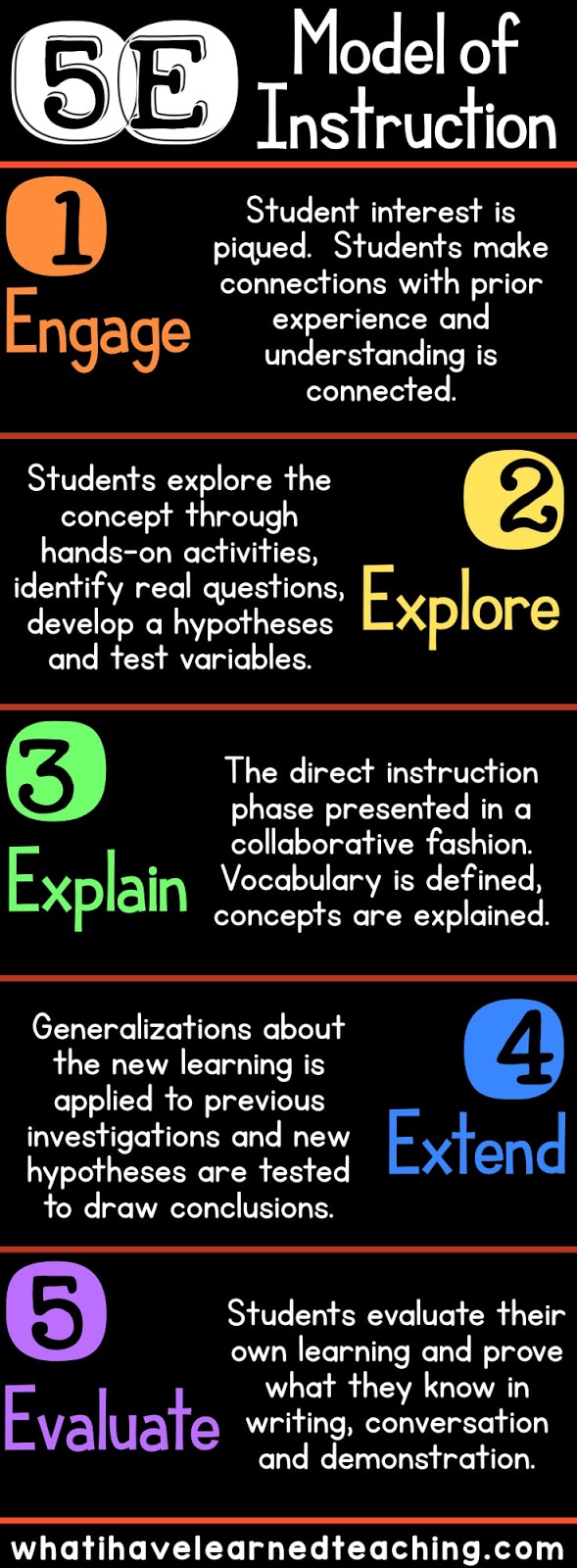
Inquiry, The Learning Cycle and the 5E Model

Active learning is based on the constructivist theory. This theory recognizes that learners will need to:
  •  express their current thinking; 

      • interact with objects, organisms, substances, and equipment to develop a range of experiences on which to base their thinking; 
     • reflect on their thinking by writing and expressing themselves and comparing what they think with what others think; and 
    • make connections between their learning experiences and the real world.
The 5E Model creates experiences for students have the opportunity to construct their understanding of a concept over time
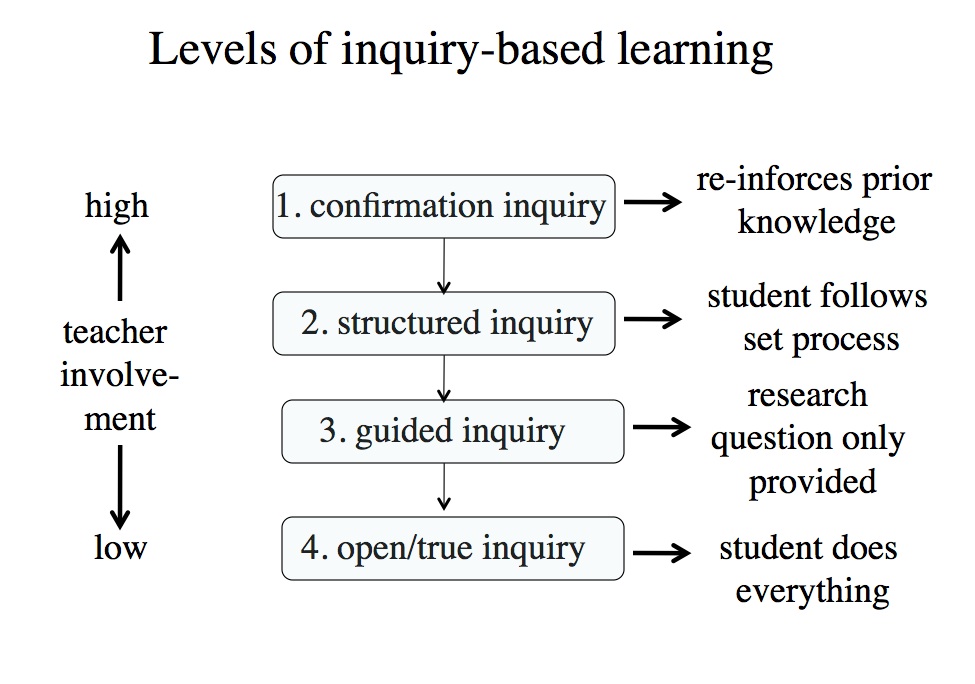
4 Types of Inquiry Based Learning
Heres my infographic:


Wednesday, September 18, 2019

Scientific Method Blog


Discover. Learn. Share.


When I first started the Scientific Method assignment I was really happy to see a Back to the Future video, I love that movie even though time travel movies tend to confuse me... 
 I found the Science Buddies website about the Scientific Method to be helpful. It not only listed and explained it step by step but it also provided linked resources for us to deepen our understanding. There was even a teacher tool-kit box. I definitely see myself referring back to this link as the semester progresses. 

The BrainPop video was helpful in explaining the process too. It was a cartoon video that was not to long and wordy which made it easy to follow and remain engaged. After the video I took the quiz, I did not do as well as I wanted the first time so I re-watched the video to brush up where I was lacking. 

The Science Buddies site stated "When direct experimentation is not possible, scientists modify the scientific method. In fact, there are probably as many versions of the scientific method as there are scientists! But even when modified, the goal remains the same"(Science Buddies, 2019).I found this interesting!


The one thing that has been made clear throughout is that the Scientific Method is not a set method. Since our world is always changing, the ways to explore and discover must adapt to these changes. Its flexible that way. You have to make the method work for whatever your situation may be, and it will not always be the same, BUT thats okay!


Steps of the Scientific Method
Science Buddies. (2019, August 29). Steps of the Scientific Method. Retrieved from 
         https://www.sciencebuddies.org/science-fair-projects/science-fair/steps-of-the-scientific-           ........method#overviewofthescientificmethod